Water Department
The Owens Valley Monitor 1999-2000
| Owens Valley
Revegetation Program Irene Yamashita, Revegetation Project Coordinator |
||||||||
| The EIR for the Inyo/Los Angeles Water
Agreement, which describes the impacts of LADWP's groundwater pumping from 1970 to 1990,
identifies more than 1,000 acres that were adversely affected by pumping. The EIR commits
LADWP to implement mitigation measures for these impacts. LADWP and ICWD have developed
mitigation plans for these lands. The plans are being implemented through the Owens Valley
Revegetation Program. As part of the implementation of this program, LADWP completed the fencing for nine of the 10 mitigation sites (see Figure 6). This measure alone could help stimulate recruitment of native species by reducing surface disturbances that can leave the sites susceptible to wind erosion. No revegetation work is planned for the site near Hines Spring until ICWD and LADWP can evaluate the influence a mitigation project at the spring that is currently in the planning stage will have on the surrounding area. Mitigation site monitoring began this year. At six of the fenced sites, permanent transect posts were installed by LADWP, and ICWD and LADWP established long-term photo points. These transects and photos will be used to monitor changes in plant cover and composition over time. Two sites are behind schedule for installation of transect posts and another site, Five Bridges, was established as a mitigation site in 1988 and has vegetation transect data collected annually. All transect post and photo point locations are being stored in ICWD's Geographic Information System for future reference. The baseline vegetation data collected in 1999 at six of the sites showed native perennial cover varying between 0.6% and 8.4%. Weed cover composed 90% to 95% of the vegetation cover at the three abandoned agricultural (ABAG) sites, Laws 118, Bishop 97, and Big Pine 160. In comparing the 1999 total vegetation cover (weeds and natives) to final cover goals, we found that the ABAG sites, although weedy, had greater cover than their respective final cover goals. This indicates that the cover goals for the ABAG sites are reasonable. These sites are capable of supporting their cover goals during a year with less than normal precipitation. In contrast, the three groundwater-impacted sites that were monitored in 1999, Tinemaha 54, Blackrock 16E, and Independence 105, had lower total cover than their respective goals. The cover goals for these sites apparently cannot be maintained by precipitation alone and will probably require a period of soil moisture recovery to attain and sustain their cover goals. Due to time constraints and the low seed production year, only scant quantities of seeds were collected in 1999. However, two new species were added, inkweed (Sueada moquinii) and desert prince's plume (Stanleya pinnata), to the program's seed bank. These additions bring the number of native plant species in the seed bank to twenty-two. |
 |
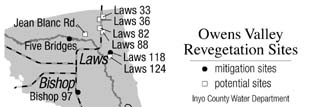 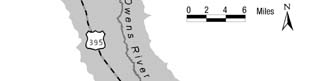 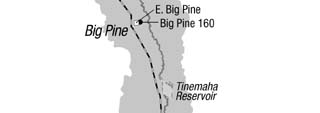  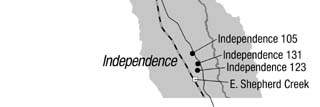 Figure 6. Owens Valley Revegetation sites. Weed control in 1999 was performed for Russian thistle (Salsola tragus), perennial pepperweed (Lepidium latifolium), and saltcedar (Tamarix ramosissima). Three hundred leaf-mining moths were released at the Big Pine 160 revegetation site, and near Jean Blanc Road north of Laws. These moths specialize in eating Russian thistle. The USDA and the Inyo County Agriculture Commissioner first introduced this moth into the valley in 1988 with little success. However, it is hoped that their presence may reduce the competitive ability of Russian thistle at these sites. LADWP continued its annual application of broadleaf-specific herbicide on perennial pepperweed near the Five Bridges area north of Bishop. And the ICWD saltcedar crew removed saltcedar from Independence 131. This site will require a minimal amount of follow-up treatment. In 1999, alkali sacaton (Sporobolus airoides) plants were grown at the Deepest Valley Native Plant Propagation Center at the White Mountain Research Station. Staff from ICWD and LADWP planted 108 alkali sacaton plants at Tinemaha 54 (near Charlie's Butte) in the autumn. These plants were watered during planting and were provided monthly supplemental water during the very dry winter. We plan to continue irrigating during the growing season for two to three years. Along with LADWP, ICWD developed a request for proposals to solicit proposals for irrigation systems and revegetation studies at two sites, Laws 118 and Independence 131. Early in 2000, we selected the consulting company SAIC, of Las Vegas. The work should begin in summer 2000. Return to the Table of Contents  |
||||||